
Currency of the North
The common people use copper (or bronze) coins. The coins most in use are pebbles and pennies, with larger purchases in groats. The silver crescent represents a month’s wages, and even then a worker would more likely be paid in groats and pennies, and possibly marks. Merchants deal in silver coins: crescents and seasons, and golden anvils for convenience.
The coins have common names—sometimes several—and customs and superstitions associated with them.
Counting
For any transaction involving more than a handful of gold or silver coins, the normal practice is “pound and count”. That is, the coins are counted out according to the agreed value of the transaction (“count”), separated into gold and silver, and weighed (“pound“). Any shortfall of more than half a coin weight must then be made up. This guards against coin clipping.
This is not generally done with the low value coins (Penny, Pebble, Groat) or with the ”coins of record”—Season and Cartwheel.
The coins of the realm of Arnor
- Copper Penny Sun
-
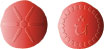
Nominally a day’s wages. Also known as a Sun. Has the Elf-runes for “Ar” on one side (for “Arnor”) and a sun on the other.
Some of the eastern people bury their dead with a penny on each eye. Although this has never been common in the North, nevertheless two pennies are associated with death and are considered unlucky. Nothing ever costs two pennies. Rather than give two pennies change a merchant would give two pennies and a twelfth. Intentionally handing two pennies to someone is a deadly challenge, usually resulting in a fight from which at most one person walks away alive. - Copper/Bronze Twelfth Pebble

-
A small, hard, shiny coin. Also known as a pebble. 12 Twelfths to a penny. Nominally an hour’s work. One pebble will buy a small glass of cheap beer in a country inn.
The normal price of a common prostitute is 5 twelfths, hence the phrase “five hours for a quarter (hour)” meaning to visit a whore. It is thus considered impolite to hand five twelfths to a woman, even as part of a different sum. This may also be the reason prices are rarely multiples of 5 twelfths. Although prostitution is a phenomenon of the cities, the avoidance of 5 twelfths is universal throughout the North. - Silver Crescent Silver Penny
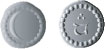
- Nominally a month’s wages. Worth 30 pennies. Has the Arnor “Ar” on the reverse and a crescent moon on the obverse. Someone hired for a ‘penny a day’ would typically be paid a crescent (30p) every four weeks (or 28 days), for an effective bonus of two day’s pay.
- Electrum Season Silver, Tuppence
-
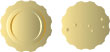
A large silver/gold (electrum) coin with scalloped edges. Also known simply as a silver or tuppence (from archaic silver penny now rarely used). Worth 2 crescents or 60 pennies.
The name derives from the Elven division of the loa (year) into 6 seasons: spring [54 days], summer [72 days], autumn [54 days], fading [54 days], winter [72 days] and stirring [54 days].
The Season is the base coin of commerce. All commercial contracts are normally calculated in silvers. Note that the crescent is a more common coin, being a more manageable value, and it would normally be Crescents that would change hands, rather than actual Seasons.
Owing to the varying lengths of the traditional Elven seasons, it is normal to hire by the “Human” month (30 days), year, or half-year, rather than by the Season per se.
NOTE: Electrum is a naturally occurring alloy of gold and silver. The season is actually a silver coin with a small amount of gold added to keep it bright. - Gold Pound Year, Tree, Pear, King

- A gold coin worth 6 Crescents. Named for its equivalence to a pound (by weight) of copper pennies (360). Nominally a year’s wages, whence it is also (rarely) called a year. Has a tree on one side and a fruit on the other. Also known as a tree, pear or king.
- Copper Cartwheel Thorn, Fortnight
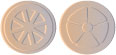
- The cartwheel is a large copper coin alloyed with silver to make it harder. The coin was never popular and has largely fallen out of use. It was minted by the dwarves for the lakemen (it was never a dwarven coin). It looks like electrum, or silver, but is mainly copper. It is large and heavy (hence inconvenient) and very hard. It has a wheel on one side and a rose on the other.
The nominal value is 14 pennies or two weeks work, except that normal practice pays 15p for two weeks work, at least one factor in its unpopularity.
It is known as the cartwheel, thorn (from the rose) or fortnight.
Owing to its size and weight it is sometimes used as a throwing weapon, or as weight for a cosh. Its hardness means it will take an edge. Hence the phrases “hit with a cartwheel” or “hit with a sharpened cartwheel”.
Some traders will not accept cartwheels at all, others will only give 12p value for them, leading to the common phrase “to pay in cartwheels” meaning a 12/14 discount (or more generally any discount). “To pay in cartwheels” is also thieves’ cant meaning to knock someone out.
“I’ll give you two cartwheels for a crescent” is a good natured insult meaning “what kind of a fool do you take me for?” i.e. “I wouldn’t expect you to give me a coin worth 30p in exchange for two worth 12p, so don't treat me as a fool”.
Cartwheels are usually only found circulating at their face value around the Long Lake.
Elven and Dwarven currency in common use
Coins of both the elf and dwarf realms also circulate interchangeably in the North. The common point of reference for both these alternate currencies is the silver/electrum Season.Elven coins
- Silver Week

-
A small silver coin known in the common tongue as a week. 10 weeks to a season, 6 Arnor pennies to a week.
Some hard masters might pay four weeks per month rather than a crescent, i.e. 24 pennies rather than 30. Hence the phrase “Elven wages” to describe poor pay or sharp dealing. - Silver Quarter

- A medium silver coin worth ¼ Season (15 Arnor pennies). The coin shows two moons, one on each side half a synodic month apart.
- Silver Moon
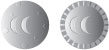
- A large silver coin exactly equivalent to the Arnor season. Shows two moons at the same phase on both obverse and reverse, against a field of stars on the obverse and against a starburst on the reverse.
- Mithril Star Elven Penny

- A small mithril silver coin worth 10 seasons (600 Arnor pennies). About the same size as an Arnor twelfth and known as an elven penny. Rare.
Dwarf coins
- Bronze Groat

- The dwarven penny. 15 groats to the season, 4 Arnor pennies to a groat. A common and useful coin.
Source of a number of descriptive phrases.- A dwarf day’s work
- Four times as much
- Paid like a dwarf / paid in groats
- Hugely overpaid. Insulting unless said of a dwarf!
- Paid like a dwarf…and worth every groat
- Expensive but worth it. Also used as a simple compliment on a difficult job well done
- Eight groats a month
- On to a good thing. 8 groats (32p) rather than 1 crescent (30p) is a common enough contract
- Silver Mark Silver Mark

-
3 groats to the mark. Worth 1/5 of a season or 12 Arnor pennies.
The phrase “two silver dwarves for an elf” describes a very bad bargain indeed (with overtones of being ‘taken for a ride’) since the original phrase was “two silver dwarves for an elven penny”, i.e. 2/5 of a season for 10 seasons, the elven penny being a very large denomination coin indeed.
A plain Mark means a Silver Mark rather than a Gold Mark, however legal contracts will always refer explicitly to Silver Marks. - Gold Anvil Trey

-
Has a hammer on one side and the name of a forge on the other.
10 marks to the anvil. Worth two seasons. Also known as a trey. - Gold Gold Mark Palace
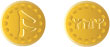
- A large gold coin. Has a “D” rune on one side and the name of the forge on the other.
Usually called a gold mark to distinguish it from the silver mark.
8 anvils to the gold mark. Worth 16 seasons. Also known as a palace.
Relative values
| bronze twelfth | copper penny | silver crescent | silver season | gold pound | copper cartwheel | silver week | silver quarter | silver moon | mithril star | copper groat | silver mark | gold anvil | gold mark | ||||
|---|---|---|---|---|---|---|---|---|---|---|---|---|---|---|---|---|---|
| Name | Realm | Metal | 1/12 | 1 | 30 | 60 | 360 | 14 | 6 | 15 | 60 | 600 | 4 | 12 | 120 | 960 | |
| twelfth | Arnor | bronze | 1/12 | 1 | 1/12 | ||||||||||||
| penny | Arnor | copper | 1 | 12 | 1 | ||||||||||||
| crescent | Arnor | silver | 30 | 360 | 30 | 1 | 5 | 2 | |||||||||
| season | Arnor | silver | 60 | 720 | 60 | 2 | 1 | 10 | 4 | 1 | 15 | 5 | |||||
| pound | Arnor | gold | 360 | 4,320 | 360 | 12 | 6 | 1 | 60 | 24 | 6 | 90 | 30 | 3 | |||
| cartwheel | Arnor | copper | 14 | 168 | 14 | 1 | |||||||||||
| week | Elf | silver | 6 | 72 | 6 | 1 | |||||||||||
| quarter | Elf | silver | 15 | 180 | 15 | 1 | |||||||||||
| moon | Elf | silver | 60 | 720 | 60 | 2 | 1 | 10 | 4 | 1 | 15 | 5 | |||||
| star | Elf | mithril | 600 | 7,200 | 600 | 20 | 10 | 100 | 40 | 10 | 1 | 150 | 50 | 5 | |||
| groat | Dwarf | copper | 4 | 48 | 4 | 1 | |||||||||||
| mark | Dwarf | silver | 12 | 144 | 12 | 2 | 3 | 1 | |||||||||
| anvil | Dwarf | gold | 120 | 1,440 | 120 | 4 | 2 | 20 | 8 | 2 | 30 | 10 | 1 | ||||
| gold mark | Dwarf | gold | 960 | 11,520 | 960 | 32 | 16 | 160 | 64 | 16 | 240 | 80 | 8 | 1 |